
Meeting Redesign : How to decouple meeting impact from resource consumption ?
APCER & Hotspot 2025's Dematerialization and Circular Experience Practice
Circularity doesn't happen out of thin air; they're designed!
The mountains of foamed boards piled up at the back door of thevenue, the dismantled disposable wooden partitions, and the paper brochuresscattered all over the floor awaiting recycling are occupational hazards andlinear costs that the convention and exhibition industry has long neglected. Inthe past, we were used to comforting ourselves by saying that we were doingsustainability by "collecting ID badge sleeves on-site and sortinggarbage." However, from the perspective of the ISO 59000 circular economystandard, such post-event remediation cannot stop the continued exploitation ofprimary resources and may even carry the suspicion of greenwashing .
ACC has brought together international partners and threefounding partners to establish the "Re: MICE, the Taiwan Circular MICEAlliance." We advocate that the transformation of the MICE industry mustsimultaneously launch a dual transformation of the "Tangible AssetCycle" and the "Intangible Impact Cycle" to allow physicalmeetings and exhibitions to exert a real and lasting substantial impact.
Last year, ACC hosted the "APCER & Hotspot 2025,"a landmark European event held in Asia for the first time (hereinafter referredto as this case study). As the professional conference organizer (PCO)providing full-service execution, we personally witnessed this transformationfrom concept to implementation. This four-day conference, co-hosted by theMinistry of Environment, the Ministry of Economic Affairs, the Ministry ofAgriculture, and the Circular Taiwan Network, brought together 565 participantsfrom 50 countries who are concerned with the development and practice of thecircular economy. We used real-world data to verify one thing: high-qualityinternational conferences and the exploitation of native resources canabsolutely be " decoupling ."
Moreover, the dematerialization and circular design did notsacrifice the quality of the conference. Post-conference surveys showed that asmany as 90% of participants were positive about the forum as a whole, with asatisfaction rate of over 90%; and the overall goals of each session, includingthe accuracy and depth of the content, were highly praised, with an achievementrate of 90%.
"Everything wasfantastically thought through and brilliantly executed - Program deaign,Visuals, Food, Services, Signage’s , Communication, Site Visits, Timings,Interpreting, A very well organized program.” —Anh Vu, Vietnamese participant
Meeting Design: Transforming the four-day forum into a"journey to the summit".
To reverse the linear waste of traditionalexhibitions and conventions that are "held and discarded," the keylies in the decision-making logic of the project team during the planningstage. We designed the four-day forum as a shared "mountain climbingjourney," integrating dematerialization into the participants' journeyfrom an experiential perspective:
- Building relationships and designingexperiential activities : Before the trip, information on thetopics was provided through a "virtual backpack"; the welcomereception allowed participants to co-create artworks for the exhibition through"repurposing secondhand clothing," replacing the traditional largebackdrop; the third-day dinner was transformed into a "summitcelebration," using local seasonal specialties and recycled tableware.
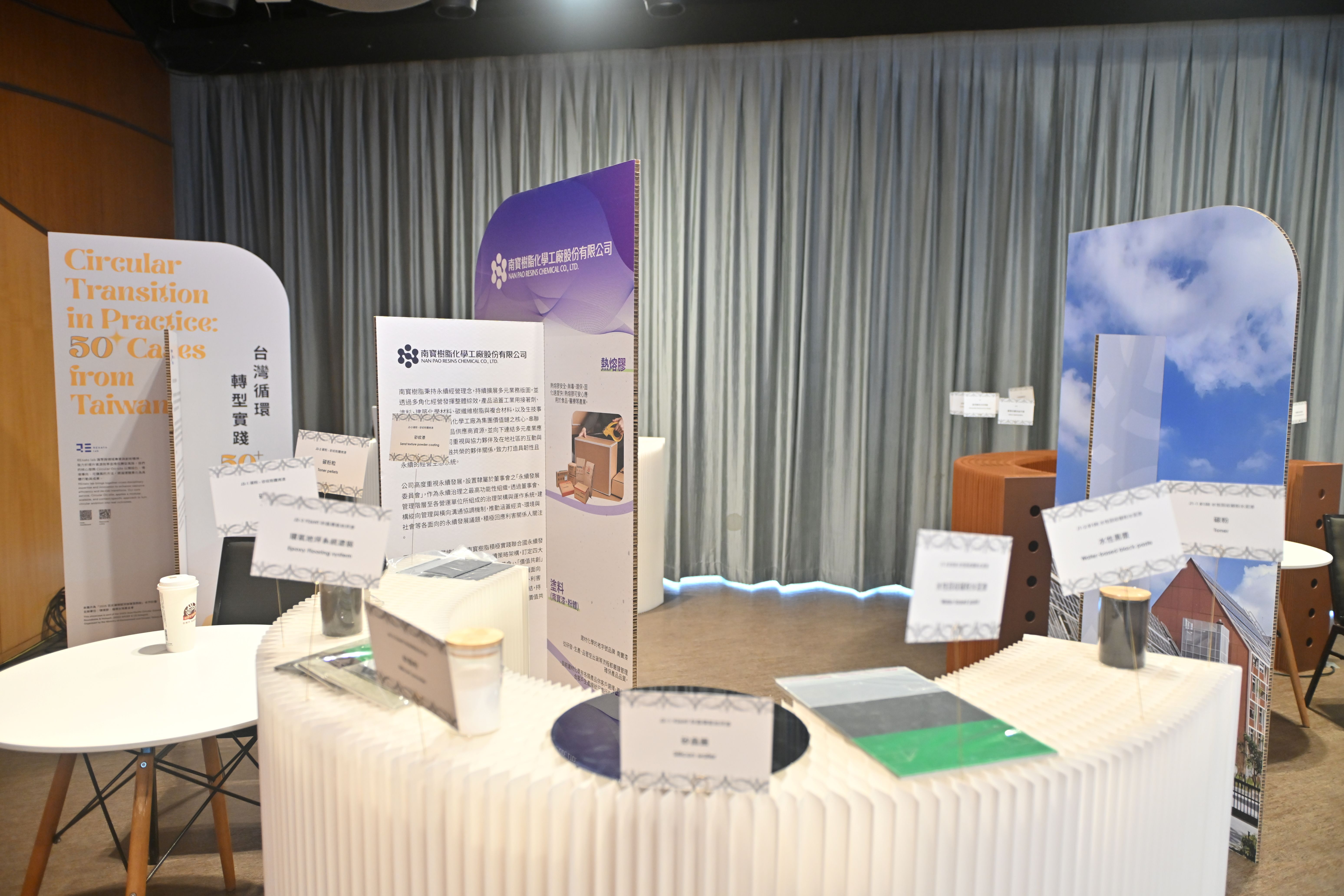
- The design of circulation and space isminimalist : the main stage and exhibition area do not use disposablewooden back panels, but instead utilize the existing equipment on site. Theexhibition area adopts an open, wall-free structure combined with re-boardrecycled cardboard, which greatly reduces the resource consumption of hardwareconstruction.
- Product servitization and dematerialization: All venue equipment, including tables, chairs, sound systems,lighting, electronic paper nameplates , and even experiential seating made frommarine debris, were safely returned to the landlord via a reverse logisticssystem after the event. Simultaneously, a comprehensive WebAPP interactivesystem was implemented, attracting over 1,000 active users and generating28,000 online interactions , replacing traditional paper brochures and businesscards, and reducing the amount of physical paper promotional materials to 32.17kg.
This service-oriented and dematerializeddesign reduces carbon emissions from the "raw material acquisitionphase," including site setup and transportation, to 2.42% of the totalcarbon emissions.
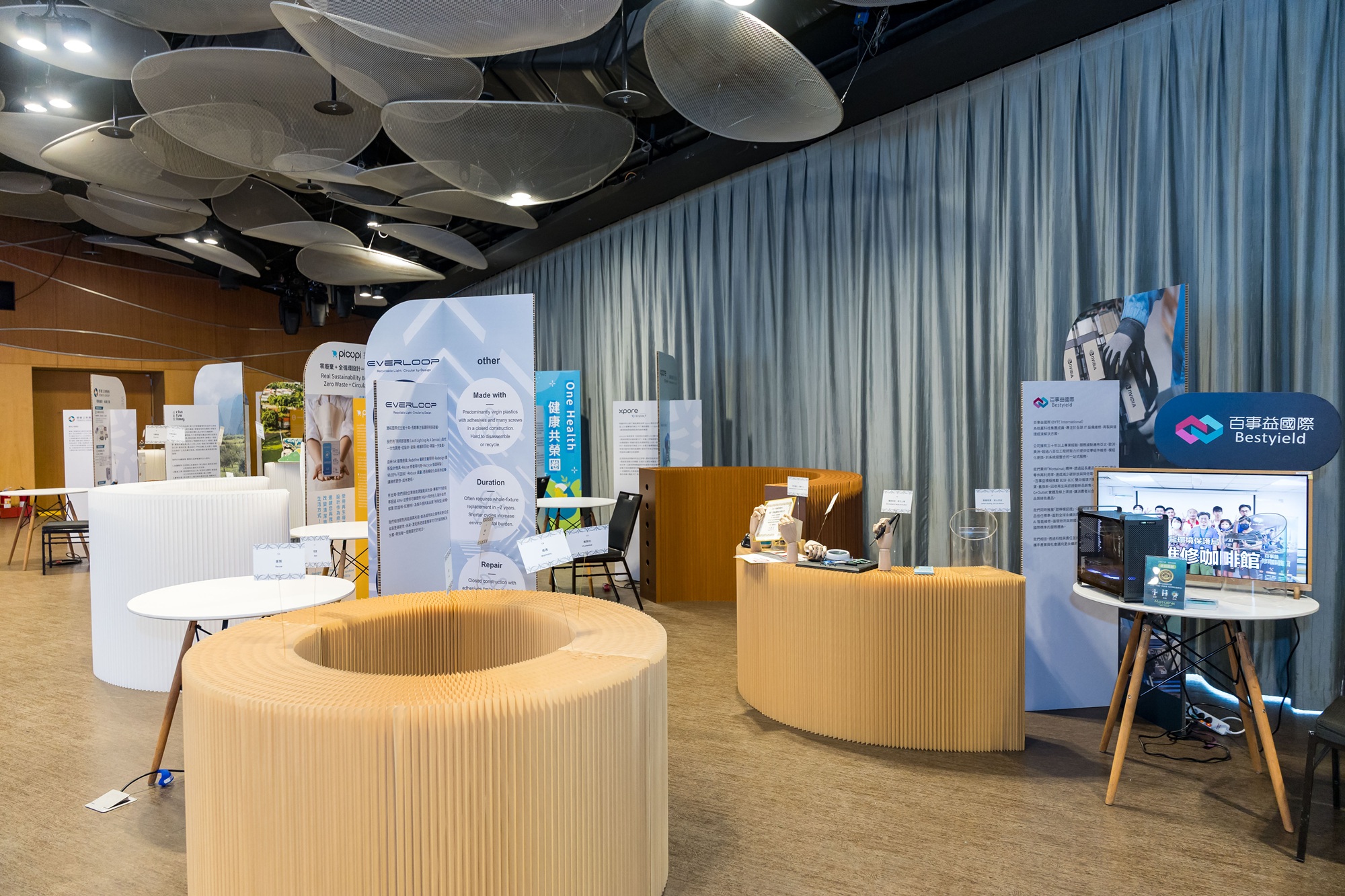
combining visual appeal, flexibility, and functionality.
DataAuthenticity: From High-Cost Carbon Inventory to ISO 59020 Material FlowAnalysis
Businesses and PCOs do not need to bear the burden of expensiveand difficult-to-track carbon inventory; by ensuring resource traceability inaccordance with ISO 59020, carbon reduction will be a natural benefit thatcomes with it.
This case set a low-carbon benchmark of only 0.805 kg CO₂ e perperson-hour . Following the meeting, the ACC team calculated the cycle lifeusing the latest ISO 59020 standard:
- Inflow Circularity reached 99.35% : ofthe total input of 4,351.77 kg of material, reused content accounted for 96.40%(4,195.21 kg), recycled materials accounted for 2.14%, and virgin non-renewablematerials accounted for 0.65% (28.35 kg).
- Outflow Circularity reached 96.55% : ofthe total output of 4,817.96 kg, 4,263.11 kg (88.48%) was returned in itsentirety as a reusable component or retained for use the following year, and388.45 kg (8.06%) entered the actual recycling and composting pipeline.
The data analysis also revealed the real carbon emissionhotspots : when venue setup carbon emissions were reduced to <3%, the truesources of carbon emissions emerged in catering services (47.03%),transportation connections (29.76%), and accommodation services (17.36%). Thisprovides precise optimization directions for future circular exhibitions.
Honestlyaddressing the gaps: Transforming data pain points into evolutionary SOPs
An objective review of the data shows that catering servicesaccount for 47.03% of the total carbon footprint . However, traditionalprocurement only leaves financial figures and lacks physical weight (kg) of thematerials. As a result, the primary weight data cannot be obtained whencalculating the cycle degree, so it cannot be included in the cycle degreenumerator.
We chose to be open and transparent about the gaps, rather thancrudely calculating material flow using financial figures. The findings of thispost-incident review have prompted ACC to directly include "food purchaseweight (kg)" and "kitchen waste weighing record (kg)" in futureprocurement contracts to complete the biological cycle data and ensure thatfuture exhibition data has 100% credibility that can be verified by thirdparties.
The diffusionof influence: making meetings a sustainable asset for businesses
Beyond the preservation of tangible resources, cyclicalexhibitions focus on creating an intangible "cycle of influence." Inthis case, we not only facilitated 43 substantial cross-border collaborationsthrough conference design, transforming topics into concrete industrycooperation opportunities; more importantly, this experience demonstrated theboundless possibilities for upgrading the exhibition ecosystem.
In the future, PCOs can be repositioned from"resource-consuming contractors" to "resource scheduling centersfor the convention and exhibition ecosystem." By redesigning cooperationmodels and implementing cross-project scheduling mechanisms, it is hoped thatthe savings in setup and transportation costs can be returned to clients, andprofits can be shared with exhibitors, making cyclical conventions a lucrativebusiness.
For organizers, the benefits of implementing a cyclical eventmodel extend to the management level. In addition to achieving projectobjectives, the event's material flow analysis report, which conforms to theISO 59000 series standards, can also provide objective quantitative data asevidence of the company's annual supply chain performance.
The APCER & Hotspot 2025 case study illustrates that one-offmeetings and sustainable cycles are not irreconcilable contradictions. As longas planning is done well from the outset, materials can circulate continuouslyin the supply chain, and the benefits created by an event can extend beyond afour-day meeting, transforming into a far-reaching impact.


.webp)


